
British Values
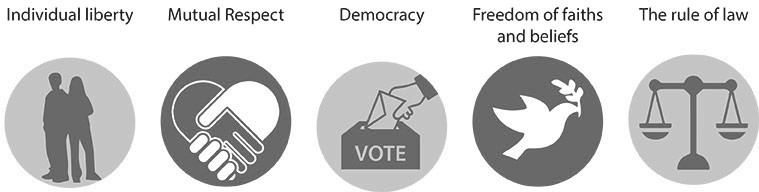
They are not displayed. They are lived. Every day.
As part of our vision to nurture today’s young people and inspire tomorrow’s leaders, we understand that character education is every bit as crucial to our pupils’ development as academic success. British values are ingrained in everything we do and represent all that we strive to achieve in our vision to nurture today’s young people and inspire tomorrow’s leaders. We encourage our pupils to live a life characterised and enriched by the values of our school. We hope that these tenets will continue to inform their choices, actions and behaviours long after they leave school, enabling them to make a positive impact on society.
We teach our pupils the importance of being kind, compassionate and respectful to everyone that they meet, irrespective of their faith, ethnicity, gender, sexuality, class or any other perceived differences. Through our leadership specialism, community service projects, and interfaith alliances, our pupils meet inspirational people from a diverse spectrum of backgrounds, beliefs and cultures, and are encouraged to embrace all that life in modern Britain has to offer.
We also consider it essential for our staff to lead by example and exemplify and model British values. British values are therefore built into our staff induction processes and reiterated in all staff training exercises.
The examples provided below – whilst by no means exhaustive – serve to demonstrate how British values permeate our curriculum, ethos and a wide range of leadership activities, along with our commitment to providing ample opportunities for our pupils to develop a strong moral foundation and a drive to make a positive impact in their local community, Britain and beyond.
Democracy
Our pupils are introduced to the concept of “democracy” and “the majority vote” from a young age, participating in leadership opportunities. Pupil voice is considered to be of utmost importance, and members of each pupil leadership team are encouraged to vote on key issues that are likely to affect their classmates, as well as bringing their own proposals to staff for consideration.
Pupils who are appointed to leadership roles are encouraged to effectively represent their area of leadership and the importance of considering everybody’s viewpoint when making an informed decision and reaching a common consensus.
Pupils are encouraged to become politically aware from a young age and participate in debates concerning age-appropriate issues, developing arguments for and against carefully-chosen topics, using our approaches to oracy in the classroom. These discussion points are woven into many curriculum areas and support pupils in learning how to put forward a strong case for causes they believe in (an essential part of the democratic process), as well as how to employ both facts and emotion in order to resonate with other people.
Democracy is also studied as part of our curriculum in PSHE, RE and History lessons, where clear contrasts are drawn between democratic and autocratic states, and the inextricable links between democracy, fairness and equality. These issues are also explored in English Literature, where the importance of democracy and/or freedom of speech often crops up as an explicit or underlying theme in texts studied by pupils.
The Rule of Law
We believe it is important for pupils to understand why rules are in place, the purpose that they serve, and the consequences of breaking them. We are keen to create an environment where pupils are able to clearly distinguish between right and wrong; and do the right thing because they want to, not simply because they feel compelled to. A key part of achieving this is through helping pupils to understand that rules are essential in order to safeguard their wellbeing, protect the welfare of others, and ensure that everybody has the opportunity to fully achieve their potential. We also teach them to understand the relationship between cause and effect and the importance of taking responsibility for their own actions, which is vital to becoming a productive and upstanding member of society. We do this through safety assemblies each half-term. Pupils quickly grow to understand that the rules that govern their school are microcosms of the laws that govern the workplace and, ultimately, society. When we live out our behaviour policy, we are drawing clear correlations between school rules and the rules that pupils encounter in their day-to-day lives, so pupils are fully aware that there are actions and behaviours which are prohibited and punishable in all contexts.
In order to ensure that pupils respect our rules, we take care to apply them fairly and consistently so that boundaries – and the repercussions of overstepping them – are clearly defined. Alongside our Behaviour Policy, we have robust Anti-Bullying and Attendance Policies. Pupils are rewarded and celebrated for exemplary behaviour through our Friday Recognition assemblies, Headteacher Award assemblies and House Points for behaviour.
We also organise visits from individuals in the legal and judicial sectors, police officers, members of the Fire Service, and road safety officers to reinforce the importance of respecting rules and the repercussions of breaking them.
Individual Liberty
We are committed to keeping our pupils safe, happy and well, and we empower them to make sensible and informed choices by providing guidance on a range of key topics, such as online safety, bullying, child sexual exploitation, physical and emotional abuse, radicalisation and extremism – all of which are built into the pastoral curriculum in an age-appropriate and sensitive manner. These issues are also explored in assemblies, interactive workshops and during PSHE lessons. Each week we have a 'Big Question' class assembly, exploring ideas around choices, respect, rights and individual freedoms and ideas.
Pupils are encouraged to know, understand and exercise their rights and personal freedoms and are advised how to recognise when these are being violated, and what to do/who to approach if they are concerned about this.
We also understand that our pupils must make their own choices and learn from their own mistakes as part of establishing their identity as individuals, and we encourage them to do so within the context of a supportive, positive and non-judgmental environment, where developing their self-esteem and self-confidence is of primary importance. Pupils are encouraged to make independent choices, resist peer pressure, and take responsibility for their own actions.
All of our pupils are valued and recognised for their individual talents and contributions and are encouraged to pursue their specific areas of interest through a variety of enrichment, sporting and leadership activities. We promote this on social media and through our 'personal achievements' display in school. We encourage pupils to see themselves as unique individuals, able to make a unique contribution to society, whilst also emphasising the importance of teamwork in achieving their goals.
Lessons are differentiated to ensure that pupils are sufficiently challenged and they are encouraged to engage in independent learning during lesson time and as part of their homework activities.
Mutual Respect
Respect is one of our core values, and we define this as simply, “treating others as we wish to be treated.” This is evidenced in the charity work and community service projects, particularly from our Pupil Leadership teams, such as litter picking in the local village and bake sales for charity. We have a zero-tolerance approach to bullying; a strong sense of community and camaraderie felt by all of our pupils; and the high standards that characterise our teaching and learning environments.
Through our oracy curriculum, pupils are encouraged to communicate openly and honestly, and to listen to – and respect – the views of others, even in instances where disagreements arise. We expect all pupils in leadership roles, as well as our staff members, to model exemplary behaviour and conduct themselves in a manner that commands the respect worthy of someone in a position of authority.
Assemblies and class work are designed to highlight the diverse nature of British society and the right for each person to be respected for their choices. We teach pupils that they should never judge a person, and encourage them to become compassionate, open-minded and accepting.
Tolerance of Different Faiths and Beliefs
We aim to promote not only tolerance, but also a genuine understanding of different faiths and beliefs by offering a culturally rich and diverse curriculum in which all major religions of the world are studied and respected. Our RE curriculum is taught through the lens of a 'world-views' approach, shifting from a traditional 'world religions' model. It incorporates both religious and non-religious perspectives.
We encourage all pupils to embrace the culturally diverse society in which they live, and by giving pupils opportunities to experience this diversity first-hand – through organising a range of interfaith activities and visits to churches of non-Christian faith. Members of different faiths or religions are also invited to school to share their knowledge and enhance learning within assemblies and in class.